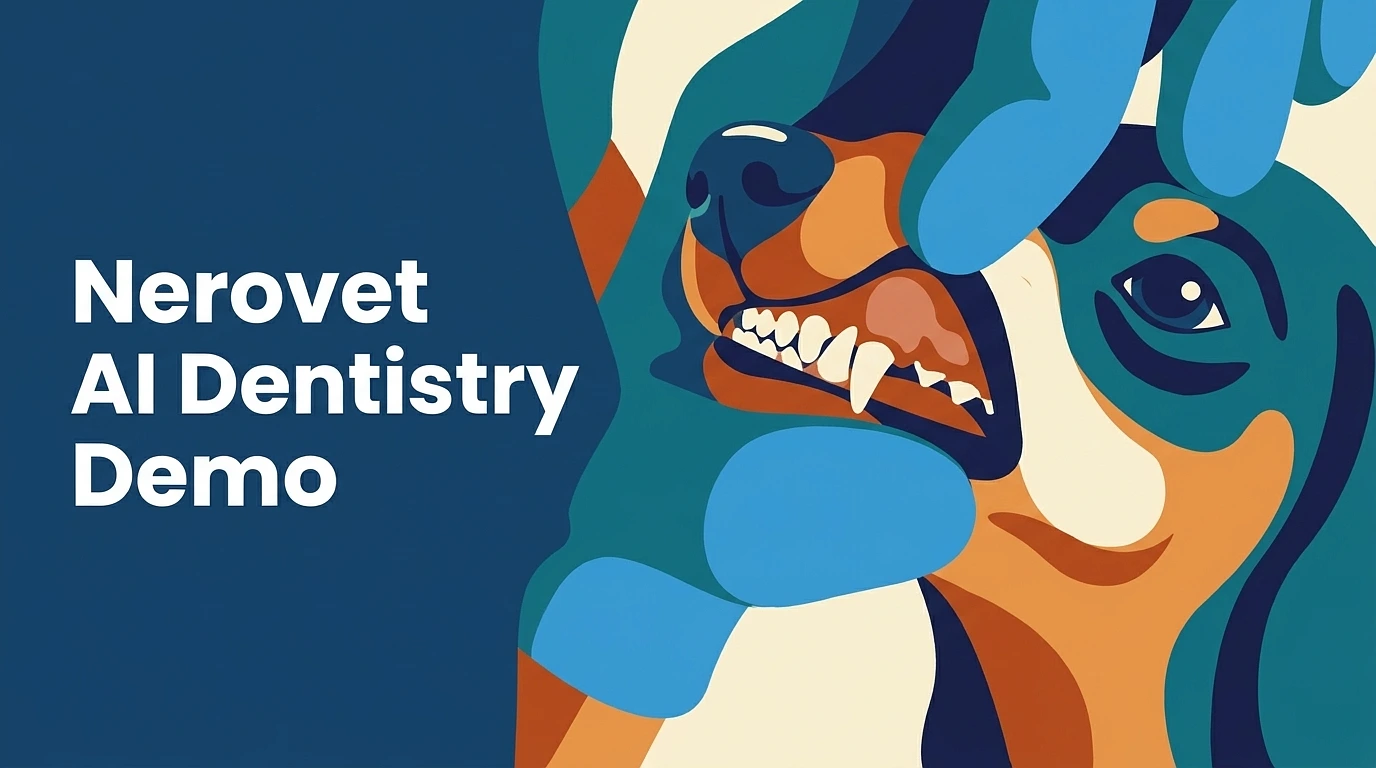
Before they age three, the majority of dogs and cats enter a clinic with dental disease, and most of it is never addressed. The Nerovet AI Dentistry Demo aims to bridge that gap. It’s a cloud platform that interprets intraoral pictures and veterinary dental X-rays to reveal to the physician what is under the gum line.
This isn’t a shortcut for diagnosis. It’s a second set of eyes, trained on dental photos of tiny animals, that picks up on things that a general practice veterinarian would not have the time or expertise to see during a hectic day. The platform’s benefits and drawbacks for clinics are listed below.
Quick Reference Table:
| Feature | What it means in practice |
|---|---|
| Inputs accepted | Digital dental radiographs and smartphone intraoral photos |
| Species supported | Dogs, cats, other small animals |
| Reported accuracy | Up to 94% agreement with board-certified veterinary dental specialists |
| Output style | Color-coded overlays on the original image |
| Access | Cloud-based portal, no on-site server install |
| Time per read | Seconds, not minutes |
| Best fit | General practices without an on-site dental specialist |
Why Dental AI Matters More for Pets Than People
X-ray evaluation is a standard procedure in human dentistry. Often, veterinary dentistry does not. Only patients who are already under anesthesia for a cleaning may have dental radiographs taken by a general practice veterinarian. They may also have eight minutes to analyze a complete mouth series while the technician sets up the next station.
Small breeds and cats make this more difficult. On film, their tooth roots overlap. They have slight modifications to their bones. Until a doctor understands precisely where to look, conditions like feline tooth resorption may seem almost normal. Because of this, a large number of dental conditions in pets go unreported until they need an urgent extraction.
What the Platform Actually Looks At
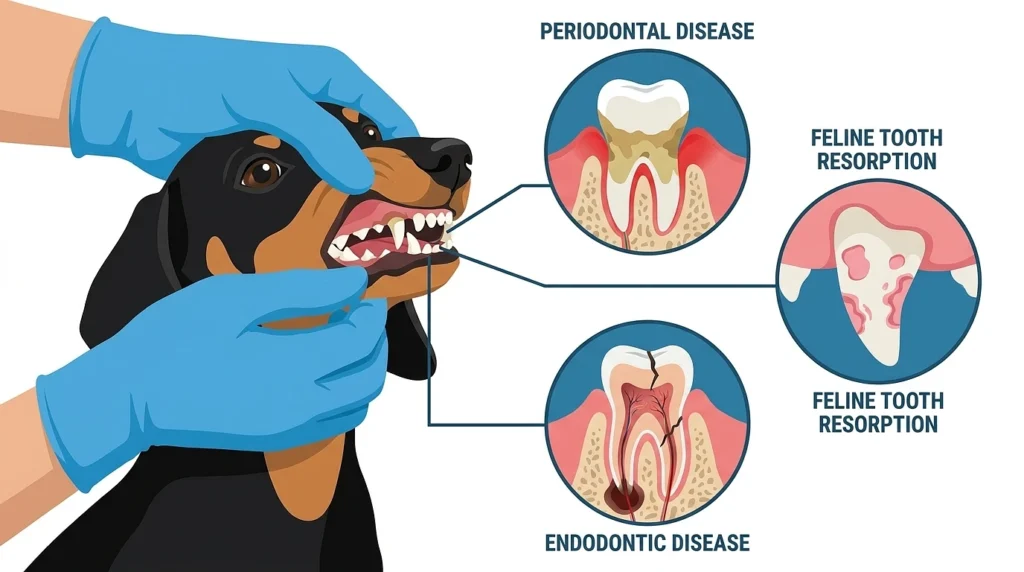
The system focuses on three pathology categories that account for most of the dental disease seen in small-animal practice.
- The first is periodontal disease, the bone loss, pocketing, and calculus buildup that slowly destroys the support structure of teeth. On a radiograph this often shows up as a fuzzy reduction in bone height along the root, easy to miss without a side by side comparison.
- The second is feline tooth resorption, where the cat’s own body slowly dissolves tooth structure from the inside. This is one of the most painful conditions in feline medicine and one of the most under-diagnosed. Cats hide it well. Owners just hear “she’s getting older.”
- The third is endodontic disease: abscesses at the root tip, internal fractures, dying pulp. These are the cases that turn into facial swelling or a systemic infection if they sit untreated for months.
Clinicians upload images through the Nerovet AI Dentistry Demo portal, the algorithm runs in seconds, and the report comes back as an annotated version of the same image they sent, not a separate document the client won’t read.
How a Real Case Moves Through It
This is shown by a regular dental procedure on a six-year-old domestic shorthair. While the cat is sedated, the technician takes a series of full mouth radiographs. The clinic’s current browser is used to submit those pictures. The analysis is already in the portal by the time the veterinarian completes the supragingival scaling, with color-coded zones showing two suspicious areas on the lower premolars and a faint pocket next to the upper canine.
After the owner has recovered, the veterinarian verifies one of the resorption lesions that were identified on the visual probe, determines that extraction is necessary, and displays the marked-up picture on a tablet to guide the owner through it. In many clinics, therapy acceptability increases in the last stage, when the owner really recognizes the nature of the issue. When “trust me” is substituted with “look at this orange highlight,” people consent to dental procedures considerably more quickly.
The Feline Tooth Resorption Problem It Helps Solve
Depending on age and the source, estimates of tooth resorption in adult cats range from one in five to more than half. The majority of early cases are never identified because dental radiographs are required for confirmation, and many clinics do not regularly radiograph every cat.
The bar for identifying these occurrences is automatically lowered by a platform that highlights resorption signatures. It doesn’t have the last say. The veterinarian continues to affirm. However, it indicates where a busy clinician should check first, which often makes the difference between detecting it at stage one and stage four.
Where It Change the Owner Conversation
A significant portion of suggested dental operations are rejected in small-animal practices due to the owner’s inability to see what the veterinarian is saying. Without exercise, bone loss is unnoticeable. A pulp shadow on a movie is the same.
Overlays with color coding alter that dialogue. A veterinarian attempting to explain periodontal pocketing in simple terms is not the same as an owner examining their cat’s real jaw with orange and red zones over individual teeth. Because the graphic makes the issue seem realistic, clinics that utilize AI overlays in consultations often report increased acceptance on borderline instances.
Honest Limitations Worth Knowing
No human or veterinary image analysis technology can take the place of a physician. About six out of every hundred instances would still benefit from a human re-check, according to the 94% agreement figure for specialist-level readings. This is before accounting for problems in picture quality, such as exposure, location, or motion blur on a patient in motion.
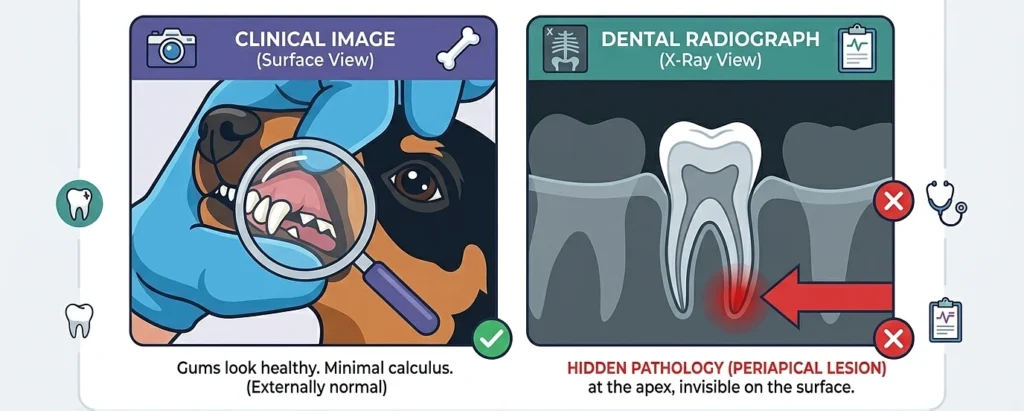
Smartphone intraoral pictures are useful for surface findings like as oral lumps, severe calculus, and broken crowns. They are unable to display what radiographs reveal. A picture is not pretended to be a radiograph by the platform. When the clinical image and the read don’t match, a specialized eye is still beneficial for anything subtle around the apex of a multi-rooted tooth.
These are not the tool’s shortcomings. Any decision-support system must deal with these. Its usefulness is in the situations it detects that a fatigued veterinarian at 4 p.m. on a Friday would have overlooked.
What Sets It Apart From Generic Imaging AI
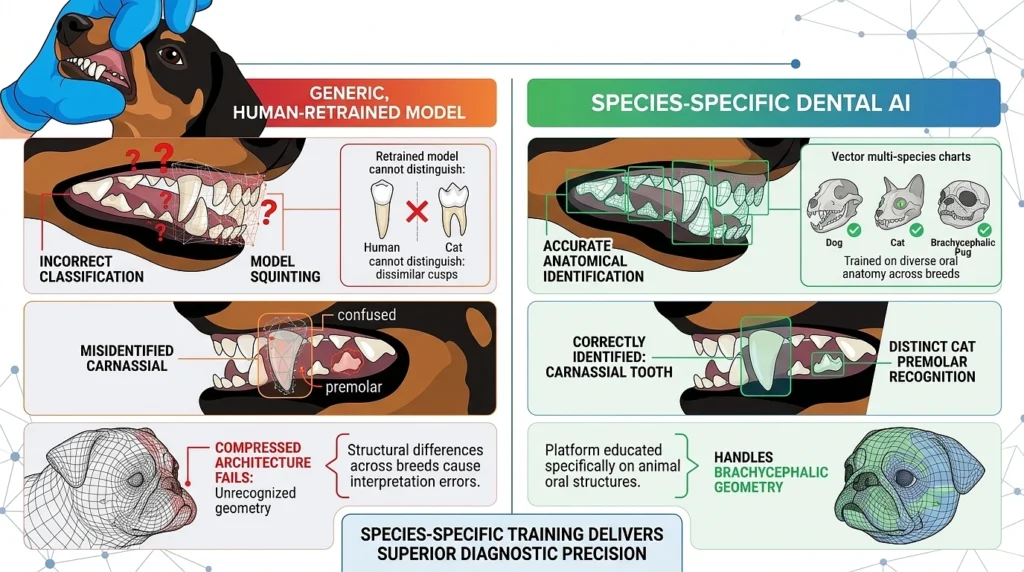
The majority of medical AI demonstrations that are marketed to veterinarians are modified versions of human radiology models with additional retraining. This seldom works successfully since the oral architecture of pets is sufficiently different. Human premolars are not like those of cats. Neither do carnassial teeth. Everything is compressed by brachycephalic skulls.
Compared to a general-purpose model squinting at unknown shapes, a platform educated especially on various animal oral anatomy across breeds is better able to manage such structural variances. Because of this, species-specific training is more important in this context than in many other AI applications.
FAQs
No. It reads them.
Yes, if the existing digital radiograph system exports standard image files.
Seconds per image once uploaded.
Mostly clinical use, though technicians doing pre-anesthetic oral checks find it useful too.
Primarily dogs and cats, with support for other small animals.
No, it’s a cloud platform. Internet access is required.
The original image returned with color-coded zones marking suspect areas, plus a short summary the vet can show the client.
Mostly for general practices. Board-certified veterinary dentists already do this read themselves. The platform is closer to giving every clinic a specialist-level second opinion.