



Bringing a pet into a home with children is one of the most rewarding decisions a family can make. Pets teach kids about responsibility, empathy, routine, and unconditional love but they also require careful matching to a child’s age, temperament, and your family’s lifestyle. The “best” pet for a five-year-old is rarely the same as the best pet for a twelve-year-old, and the right choice depends as much on the adults in the home as it does on the child.
This updated guide breaks down the best pets for kids by age and category, walks through the factors every family should weigh before adopting, and flags the common pitfalls that lead to unhappy pets and disappointed children.
Key Takeaways
The best pets for kids are those that match their age, maturity, and family lifestyle. The most popular and kid-friendly options include dogs (especially Labradors and Beagles), cats, guinea pigs, rats, and betta fish. Dogs and cats provide the deepest companionship and most actively teach responsibility, while smaller animals like rats are surprisingly social, intelligent, and trainable. Whichever pet you choose, the ultimate responsibility for its welfare always rests with the adults not the children.
Best Pets by Age and Category
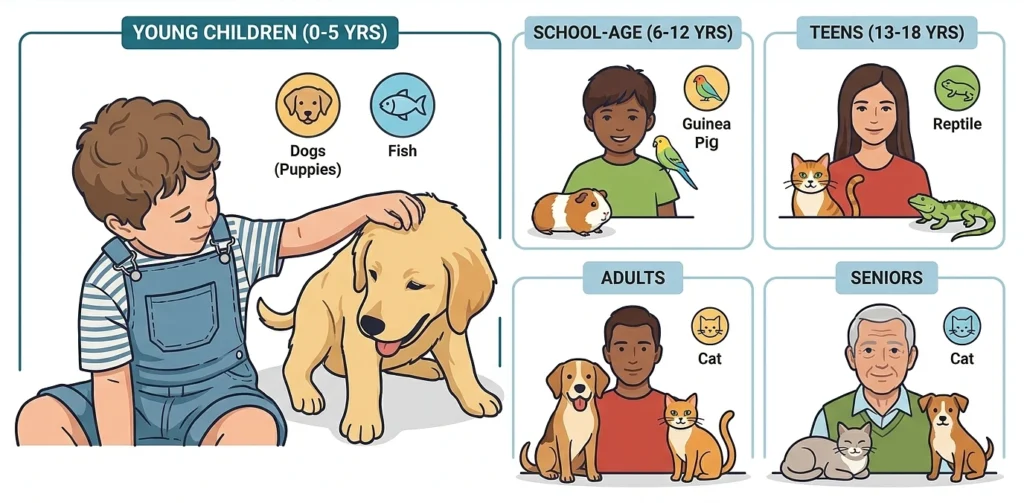
Not every great pet is a great pet for every child. Matching the animal to the child’s developmental stage is the single most important decision you’ll make.
Best Pets for Young Kids (Toddlers and Preschoolers)
Children under six generally lack the fine motor control and impulse regulation needed to safely handle most animals. The best pets at this age are ones kids can observe and bond with from a small, respectful distance.
- Betta fish are an excellent starter pet. They’re visually striking, require minimal maintenance, and there’s no handling involved which protects both the fish and the child. A betta in a properly sized, filtered, heated tank gives a young child their first lesson in caring for another living creature: feeding on a schedule, keeping the water clean, and watching quietly.
- Zebra finches are another strong choice for this age group. They’re entertaining to watch, fill the home with cheerful sounds, and live happily in pairs without needing much interaction from humans. They’re observational pets perfect for a child who wants something alive in their world but isn’t ready to hold a living thing.
Best Small Mammals (Elementary-Age and Older Kids)
Once children reach school age and can follow instructions about gentle handling, small mammals open up.
- Guinea pigs are widely considered the best small mammal for kids. They’re docile, rarely bite, and vocalize charmingly when they recognize their humans, and they’re large enough to be handled safely without feeling fragile. They do best in pairs and need daily fresh vegetables, regular cage cleaning, and out-of-cage time.
- Rats are an underrated choice and often outperform hamsters as kids’ pets. Domesticated rats are remarkably social, intelligent, and trainable many learn their names, come when called, and enjoy riding on shoulders. They’re far less prone to biting than hamsters and actively seek out human interaction. The downside is their relatively short lifespan (typically two to three years), which families should discuss with children in advance.
- Hamsters can work but come with caveats. They’re nocturnal, which means they’re often asleep when kids want to play and active when kids should be in bed. They can be nippy if startled or woken suddenly, which makes them a poor match for very young or loud households. A Syrian hamster handled gently from a young age by an older, calm child can be a wonderful pet.
Best Social Pets
For families ready to commit to a pet that integrates fully into daily life, dogs and cats remain the gold standard.
- Dogs offer the deepest companionship of any pet, but breed matters enormously when kids are involved. Labrador Retrievers and Golden Retrievers are perennial favorites for good reason they’re patient, gentle, eager to please, and built for family life. Beagles bring a smaller-package energy that suits active households. Cavalier King Charles Spaniels are exceptionally sweet-natured and well-suited to calmer homes. Whatever the breed, daily exercise, training, and socialization are non-negotiable.
- Cats offer companionship with more independence. They suit families who want a deeply bonded pet but can’t commit to daily walks. Many cats are wonderful with children, especially when adopted young and introduced thoughtfully. They also tend to fit smaller living spaces well.
Best Low-Maintenance Options
Not every family has the time or bandwidth for a high-demand pet, and that’s okay. Fish bettas, goldfish in proper tanks, or small community setups give kids something living to care for without the time commitment of a mammal. Cats, while not maintenance-free, sit well below dogs on the daily-effort scale: they don’t need walks, can be left alone for a workday, and largely manage their own grooming.
Factors Every Family Should Consider

Before bringing any pet home, walk through these honest questions as a family.
- Responsibility and age: Children can and should participate in feeding, cleaning, and playing with a pet. But the legal and ethical responsibility for an animal’s health, food, vet care, and welfare belongs to the adults in the household. Don’t get a pet expecting a seven-year-old to remember to feed it every day. Get a pet you’re willing to care for yourself, and let the child grow into greater responsibility over time.
- Time commitment: Dogs need daily exercise, training, and attention typically an hour or more across the day. Guinea pigs and rats need fresh food daily, regular cage cleaning, and meaningful out-of-cage interaction. Even fish need consistent feeding and periodic water changes. Match the pet’s needs to the time you actually have, not the time you wish you had.
- Living space and lifestyle: A high-energy dog in a small apartment with no nearby park is a recipe for stress on both ends of the leash. A pair of guinea pigs needs more cage space than people often realize. Travel frequency matters too who cares for the pet when you’re away?
- Budget: Beyond the adoption fee, plan for food, bedding or litter, routine vet care, vaccinations, emergency vet visits, and the occasional toy or piece of equipment. Dogs and cats can easily run $1,000+ per year; even small mammals are a real ongoing expense once vet care is included.
- Supervision: Always supervise young children around any pet, full stop. This protects the pet from accidental rough handling and the child from defensive bites or scratches. Teach children early that animals are not toys they have their own feelings, signals, and need for personal space.
Common Pitfalls to Avoid
A few mismatches show up over and over again in families who later regret their choice.
Rabbits look easy and aren’t. They’re often marketed as a beginner pet but are actually high-maintenance: they’re prey animals who can be skittish, they have delicate spines that can be injured by improper handling, they need significant exercise outside their enclosure, and they require specialized vet care. Rabbits can be wonderful companions for older, gentle, attentive children but they’re a poor match for boisterous young kids.
Hamsters and young, noisy households. As noted above, hamsters are nocturnal and can be nippy when startled. A toddler who wants to wake the hamster up to play is a frustrated toddler and a stressed hamster.
Reptiles as “easy” pets. Bearded dragons, geckos, and similar reptiles can be lovely pets but require specialized lighting, heating, humidity, and diet (often live insects). They’re not low-maintenance they’re differently maintenance.
Two pets at once. A new puppy and a new kitten introduced in the same week is a setup for chaos. Bring pets in one at a time, let each settle, and let your child develop a relationship with each before adding another.
FAQs
A betta fish low maintenance, no handling required, and forgiving for beginners.
Around age 5-6 for observational pets like fish, and 7-8 for handled pets like guinea pigs.
Both are great. Dogs suit active families cats fit smaller spaces and busier schedules.
Rabbits, hamsters, and most reptiles they’re too delicate or easily stressed for very young kids.